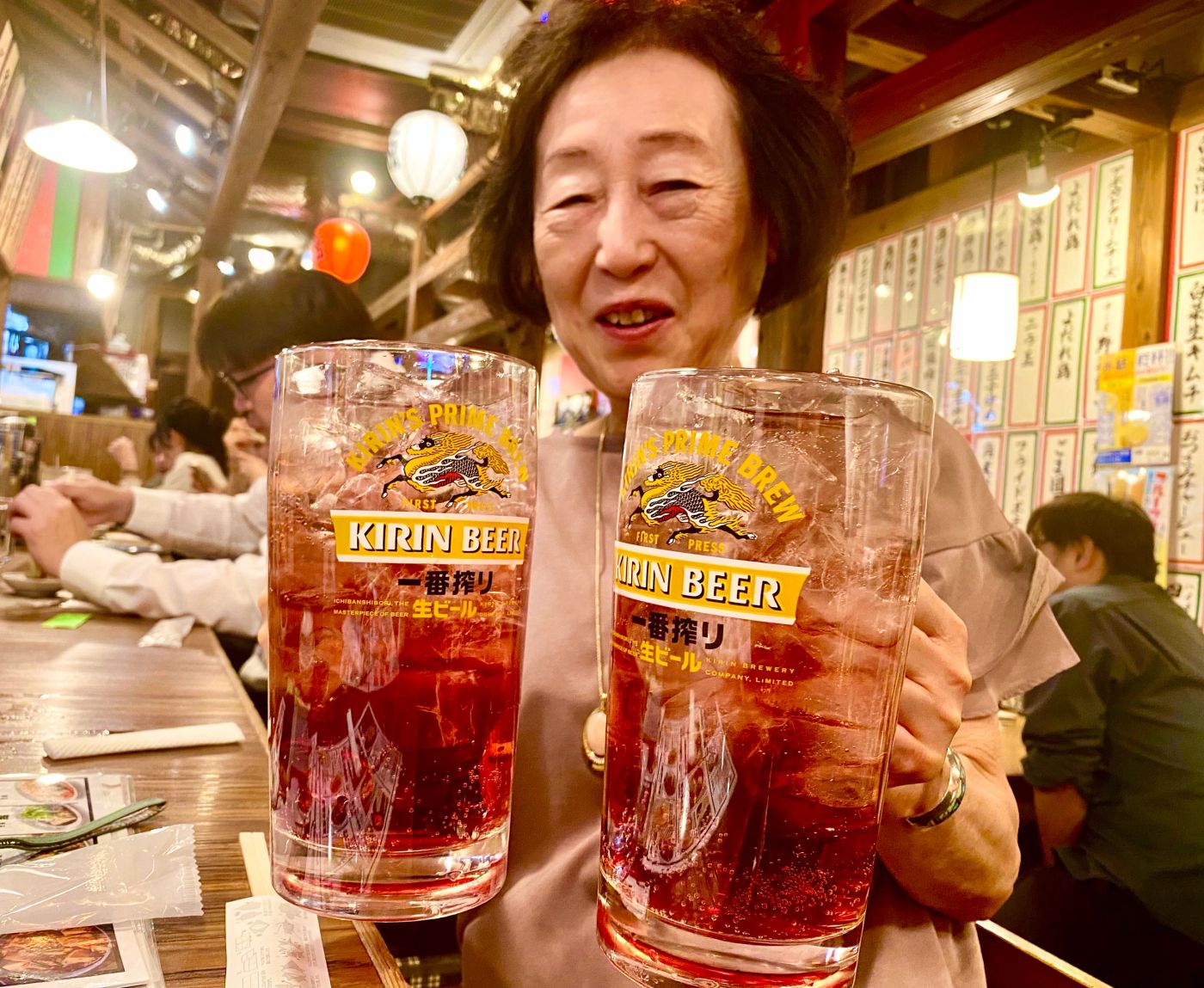
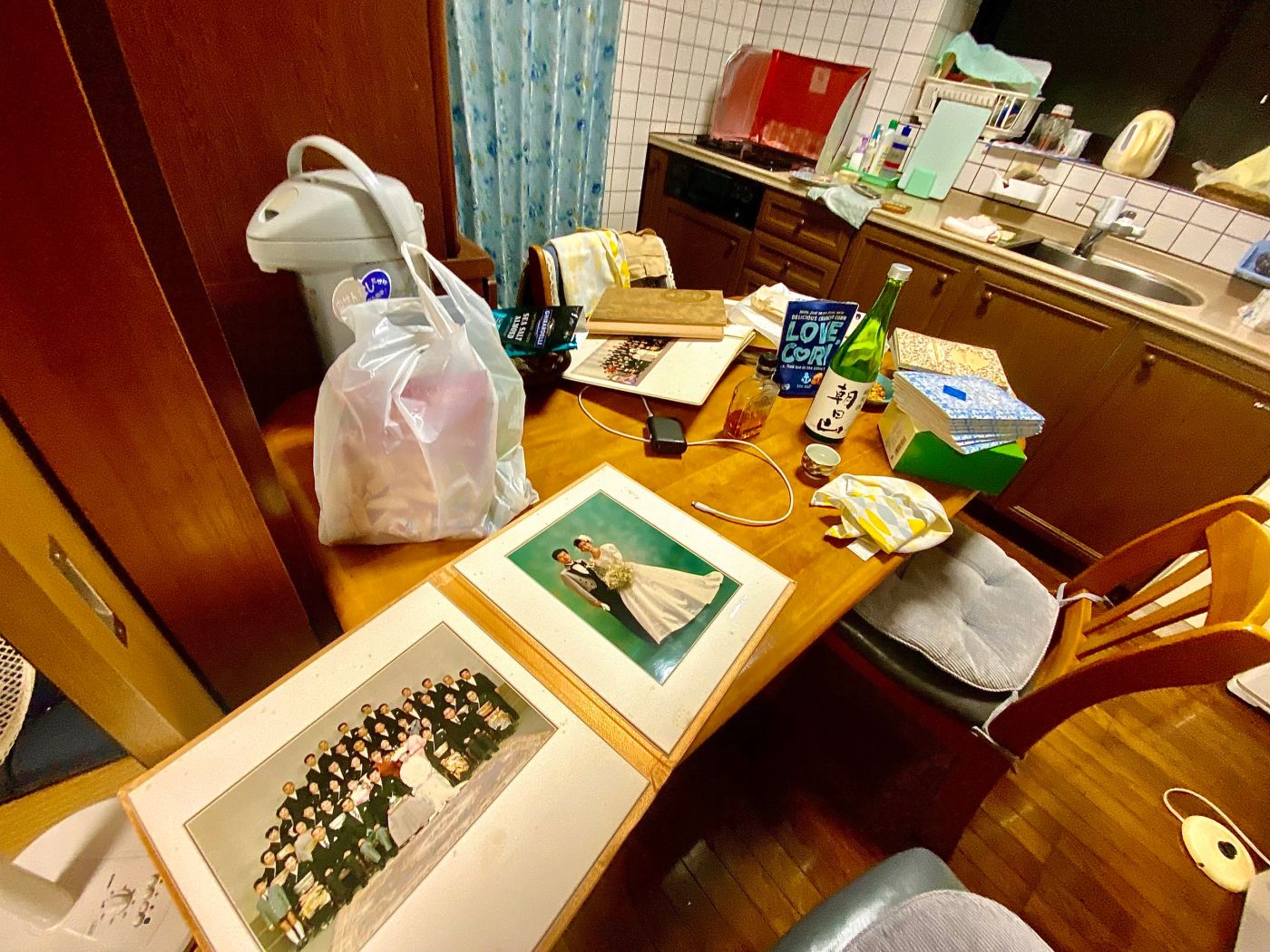
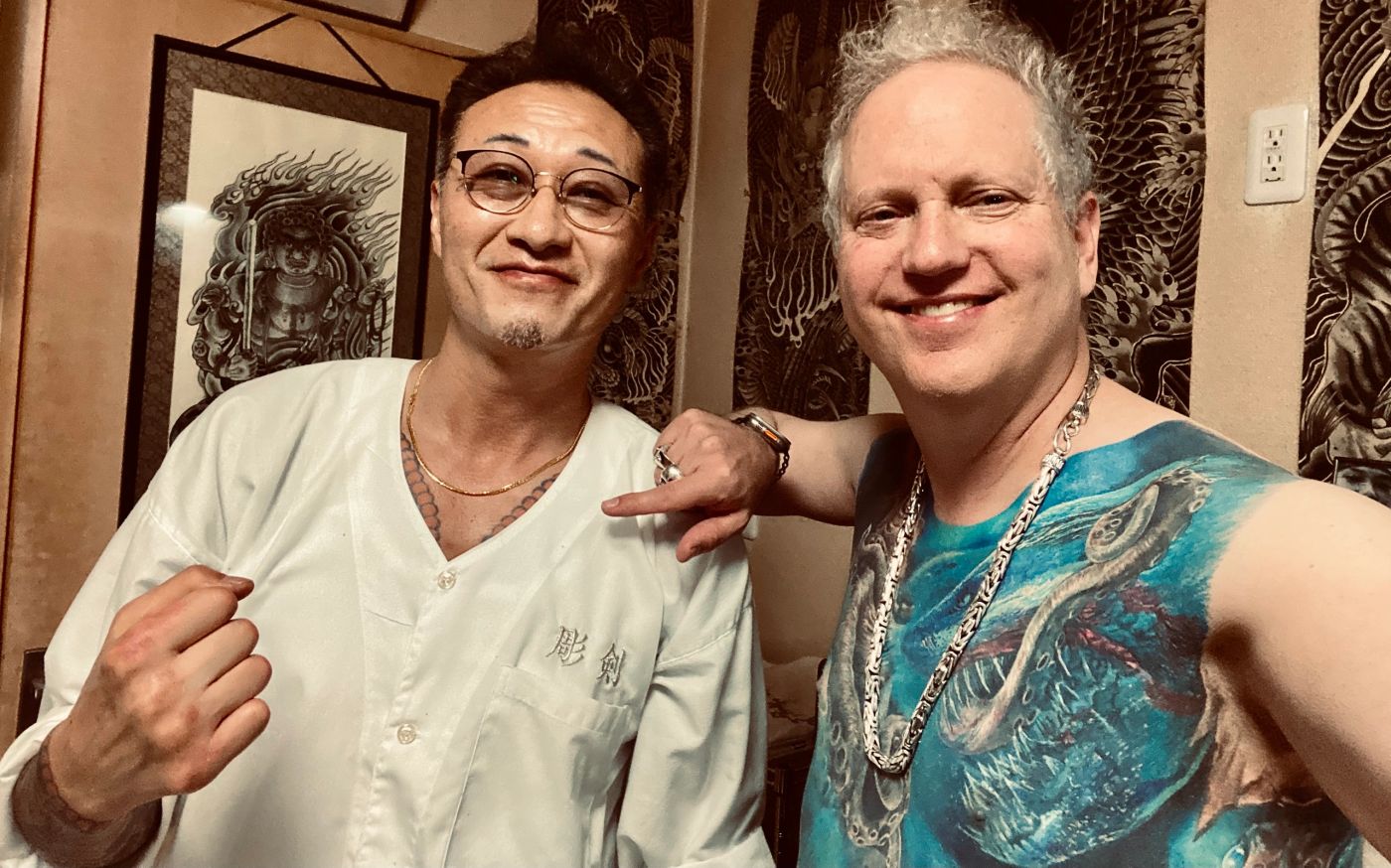
The sixth and final ink trip to Tokyo was set up just like the fourth: fly out on a Wednesday night after work, get into Tokyo early Friday morning, kill time at a diner, get set up at Humira’s place in Machida, then ink/dinner/sleep/ink/dinner/sleep/ink/back to airport and home Sunday night. The big difference was this was to be the last trip: a bittersweet finale, sweet that the leg sleeves would actually be all done, after 21 days of inking; but bitter in that this was it, I’d not be coming back to this wondrous country again, at least not soon and probably never again for inking. The almost monthly reunion with my new friends was to come to an inevitable and abrupt end. I enjoyed the time while it lasted: two dinners with Humira, plus a viewing of her family photo albums; and a drink with Horiken after the final drop of ink was instilled on the last of the 21 days.
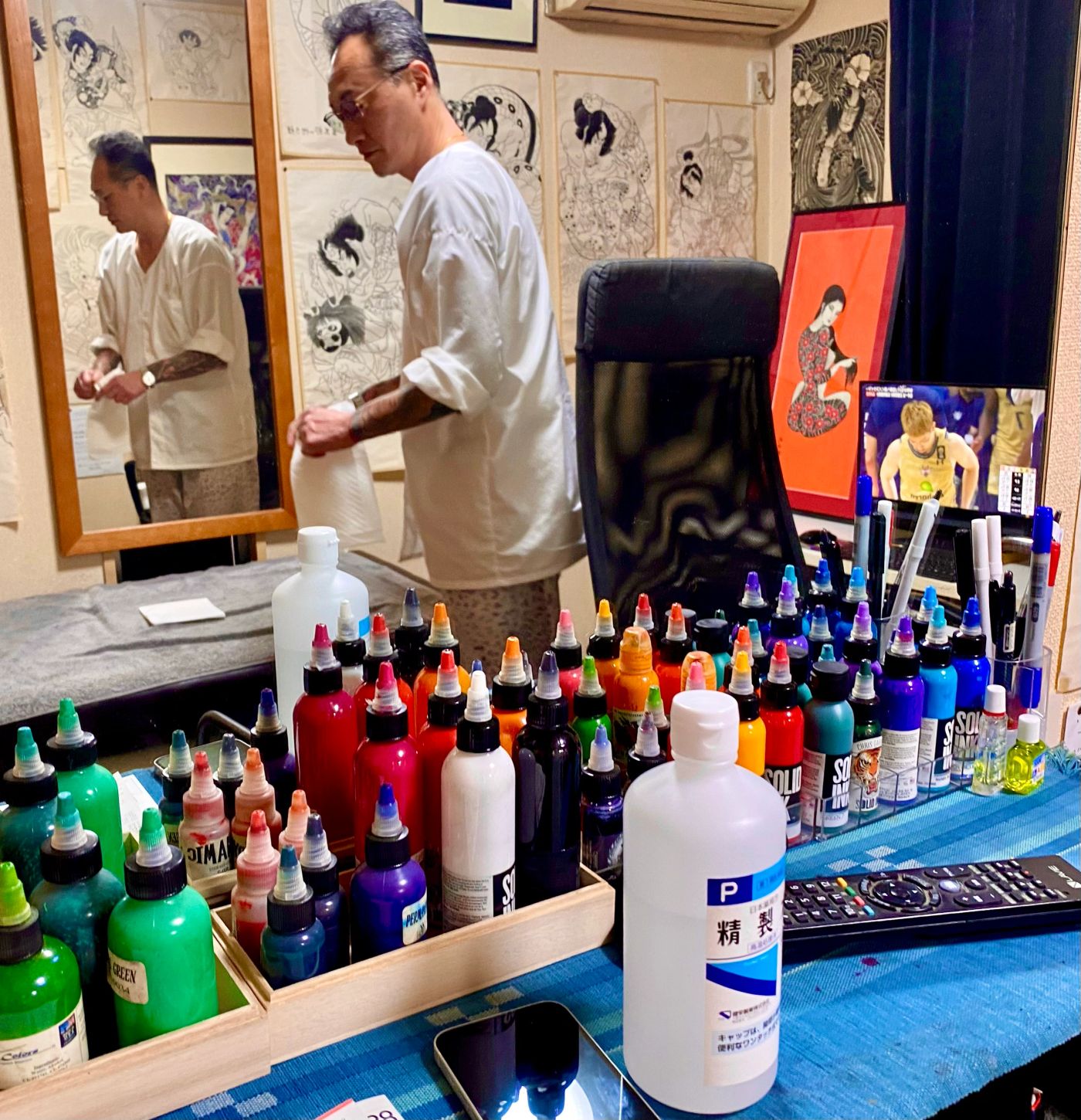
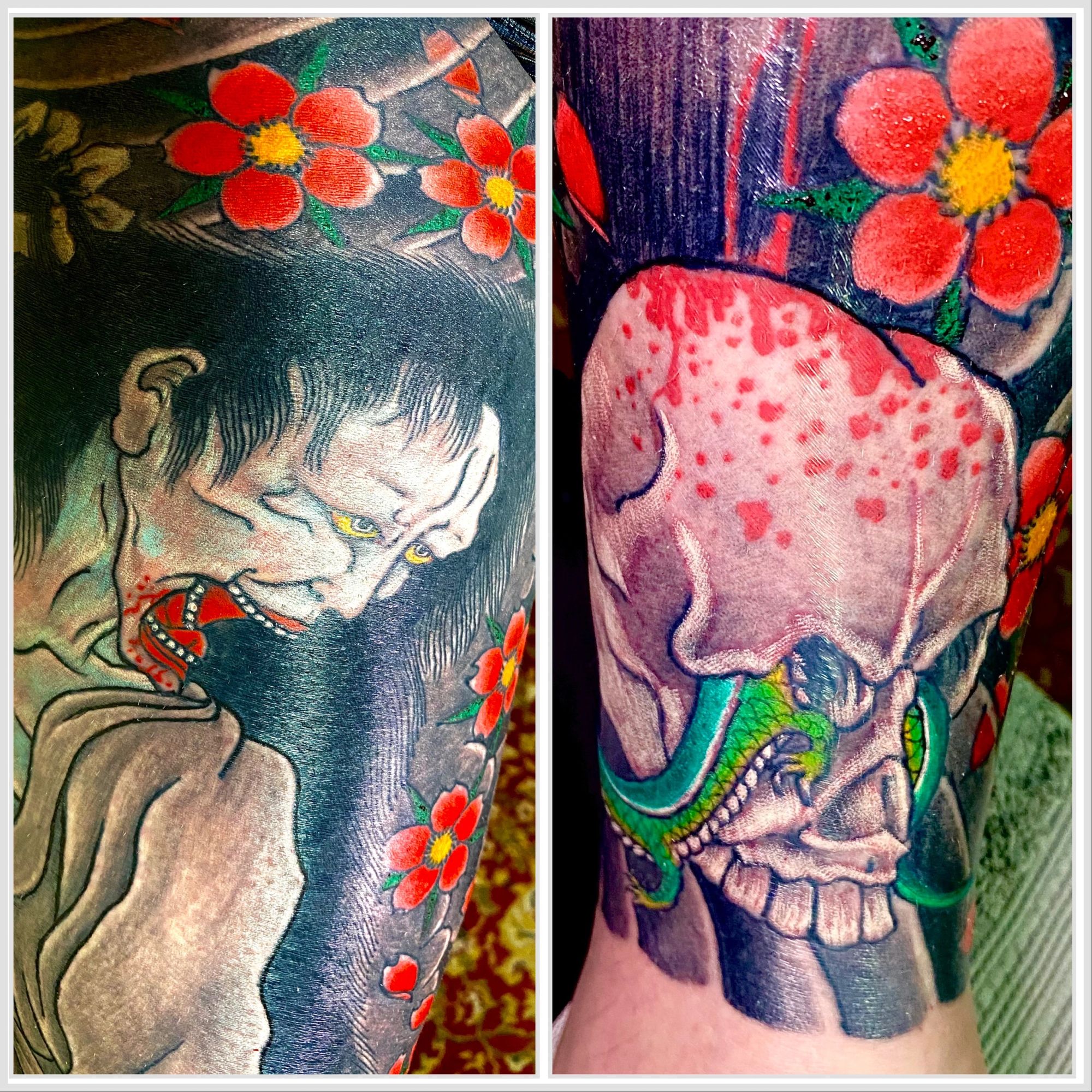
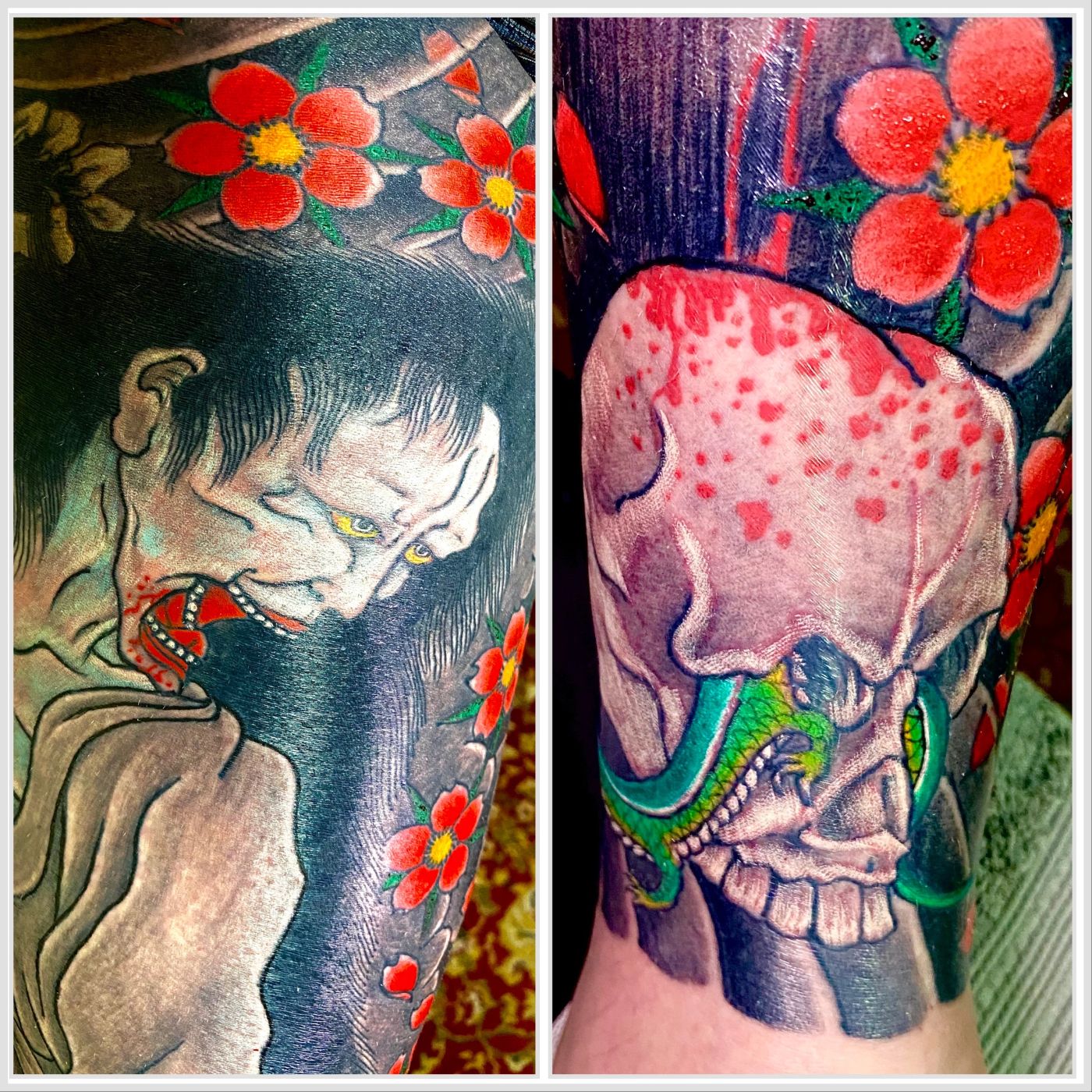
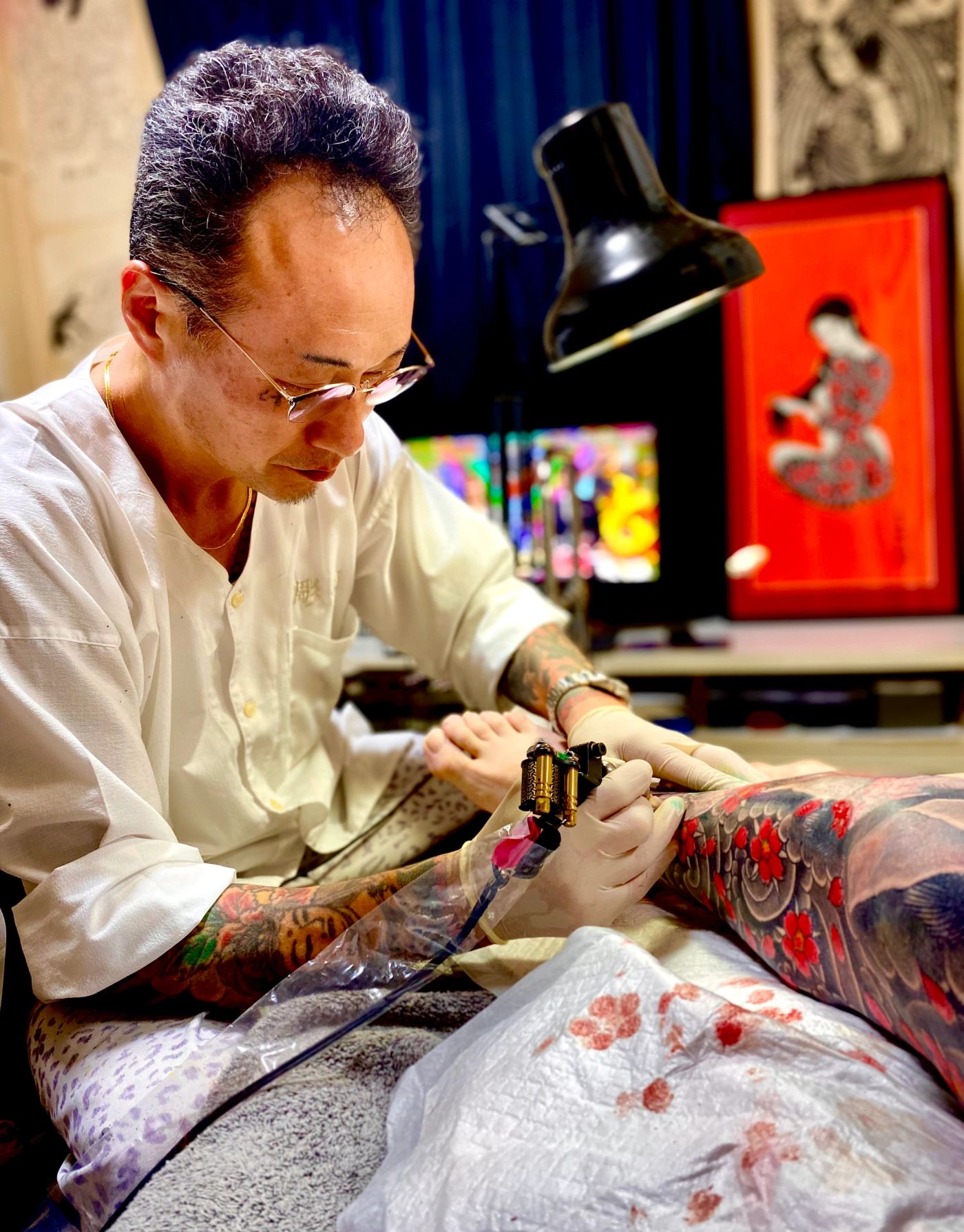
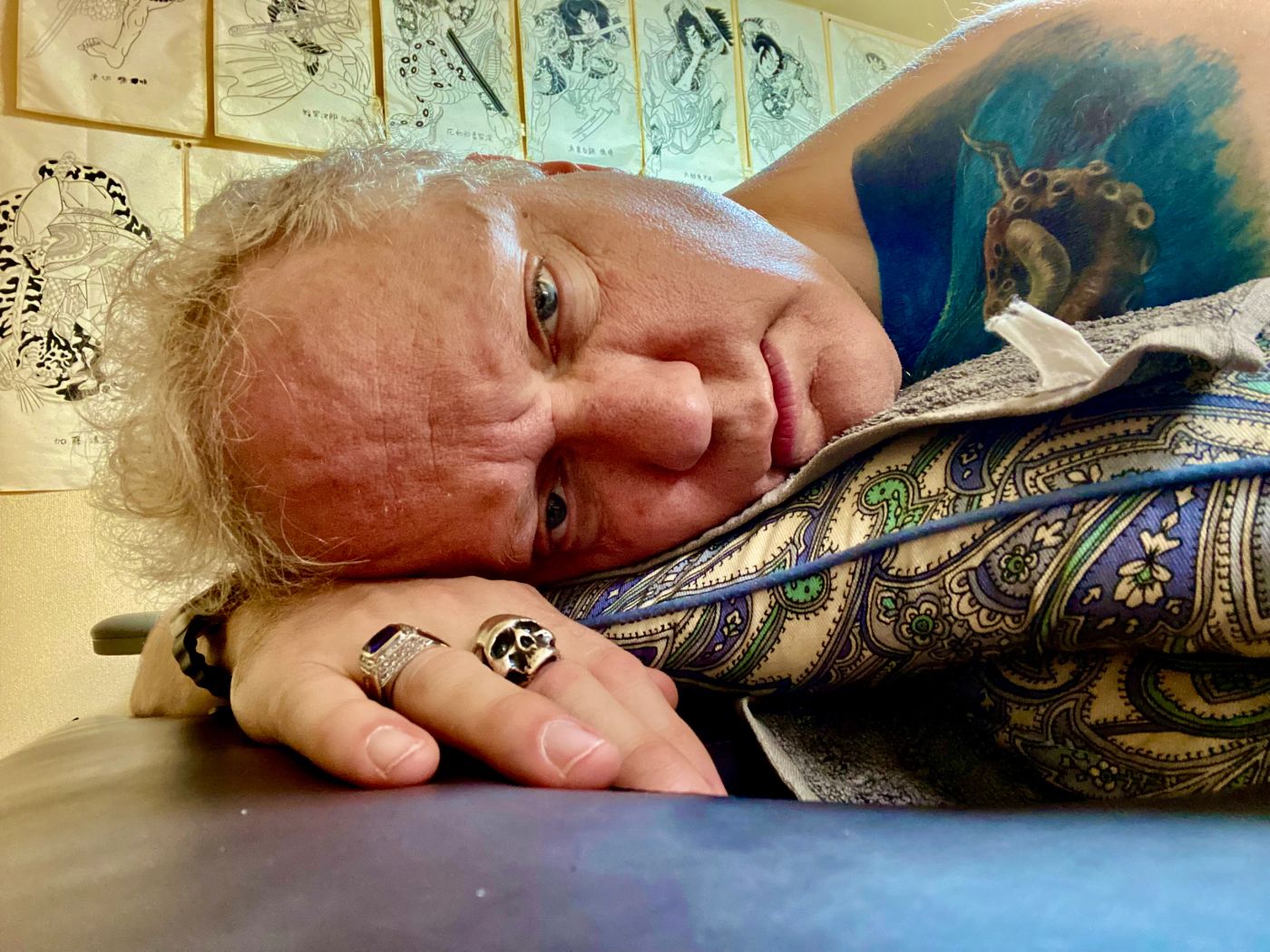
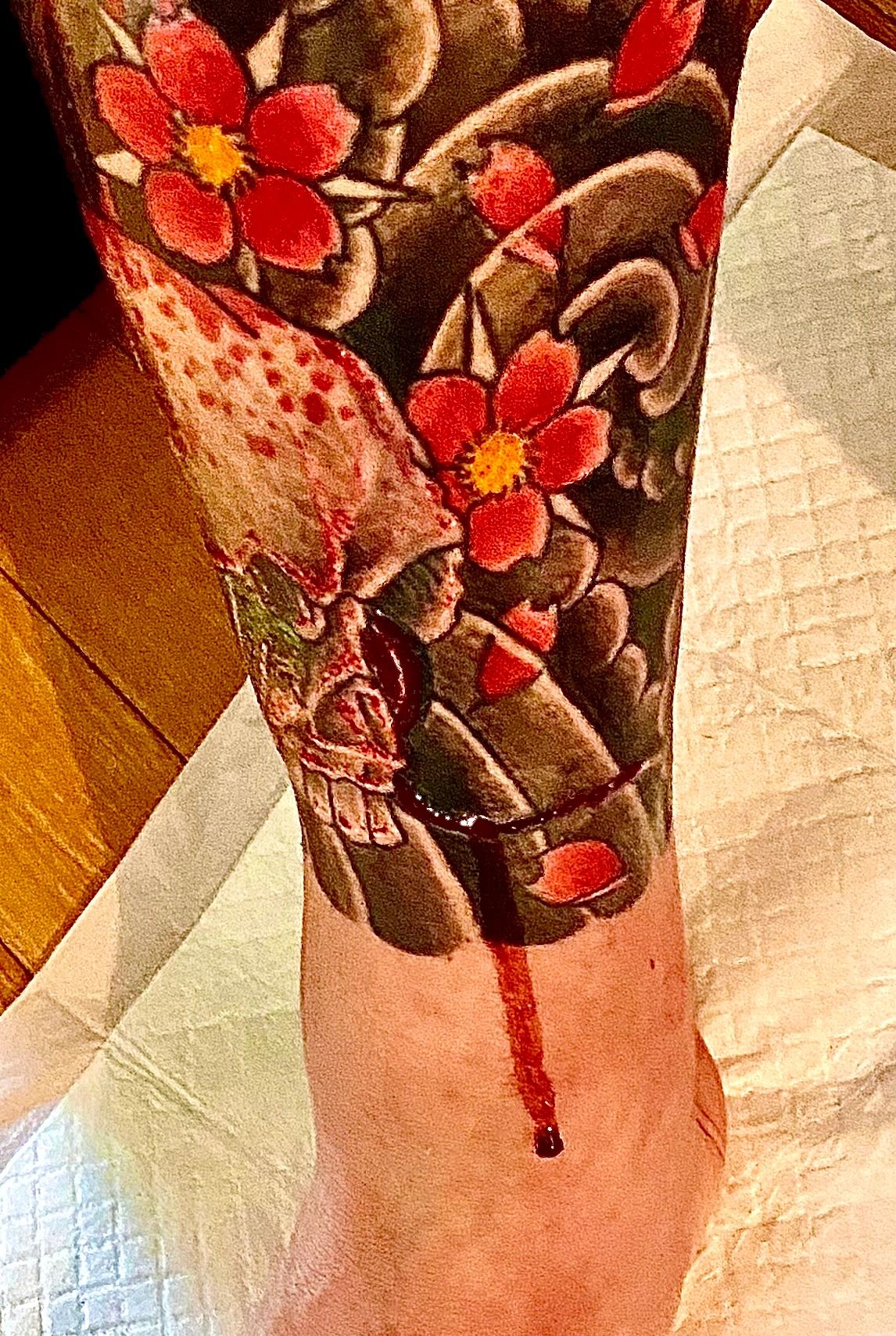
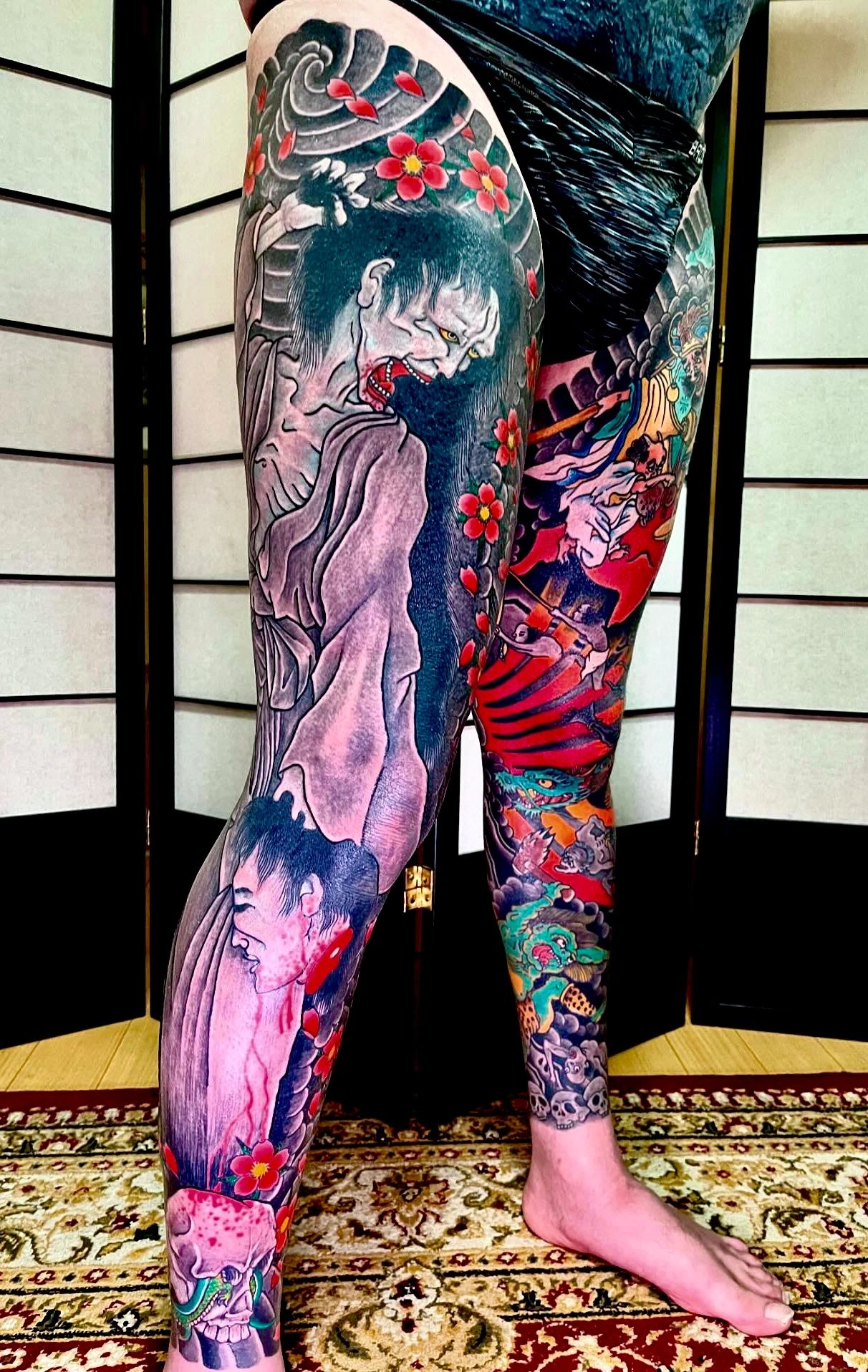
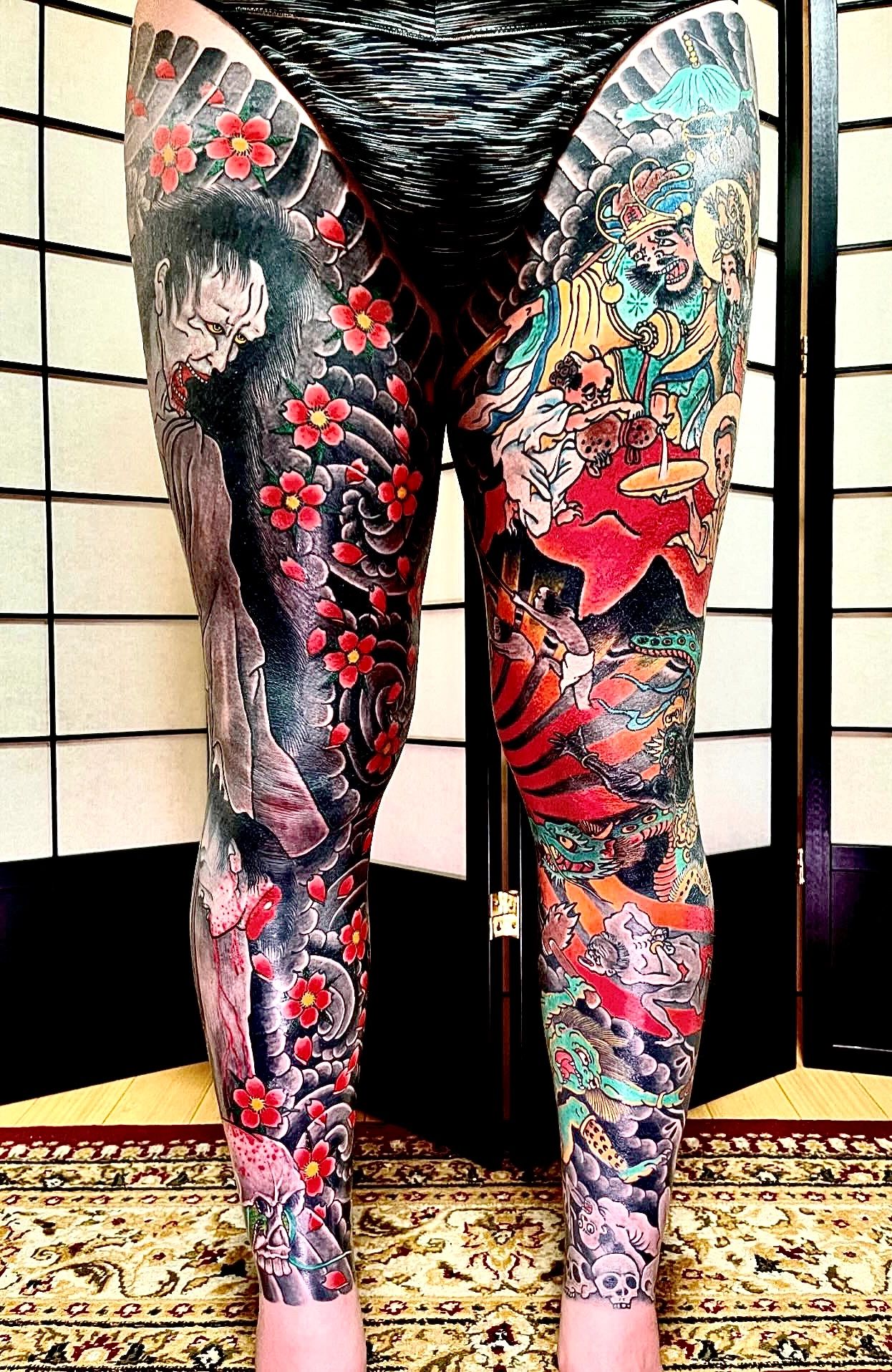
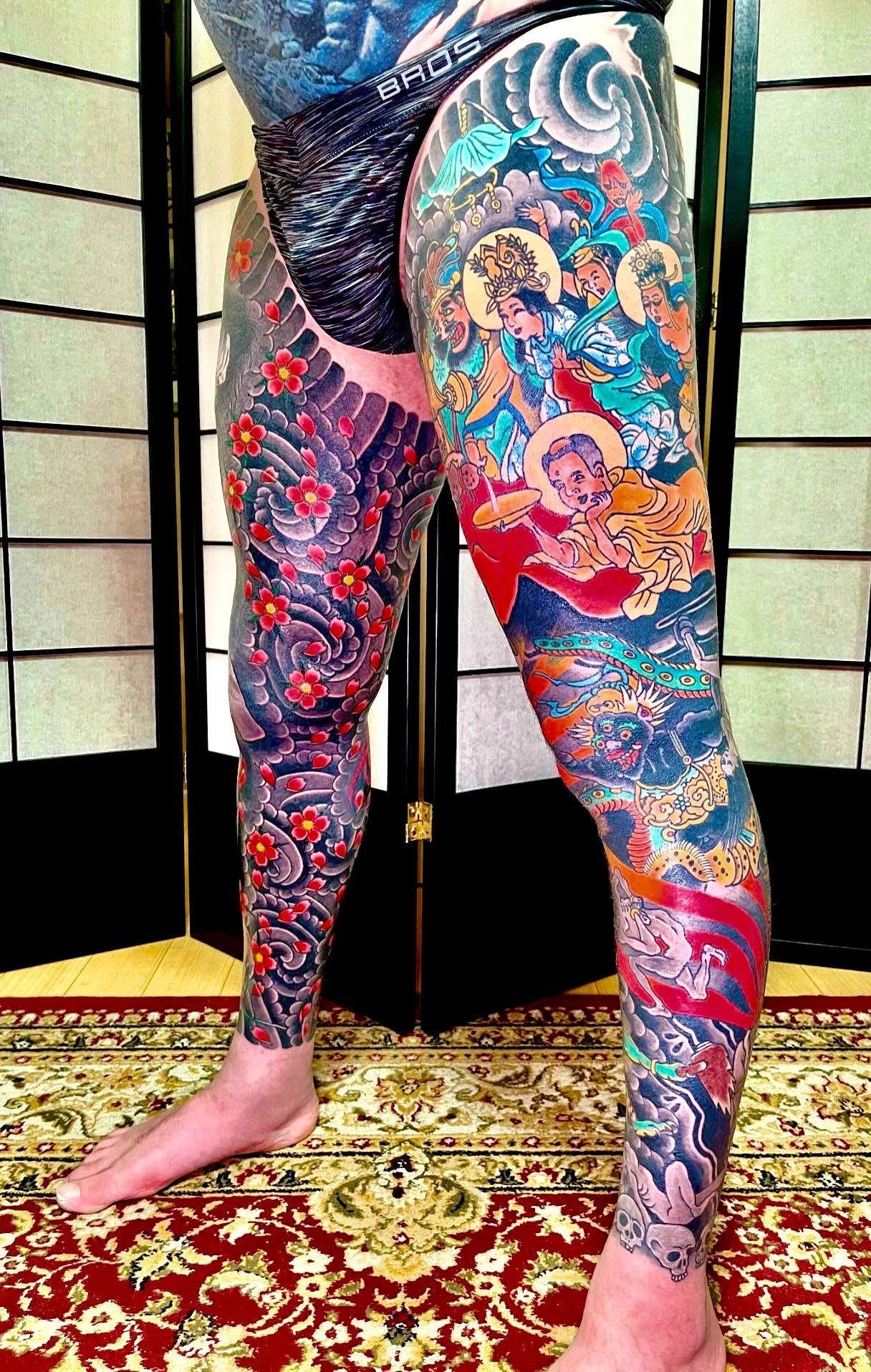
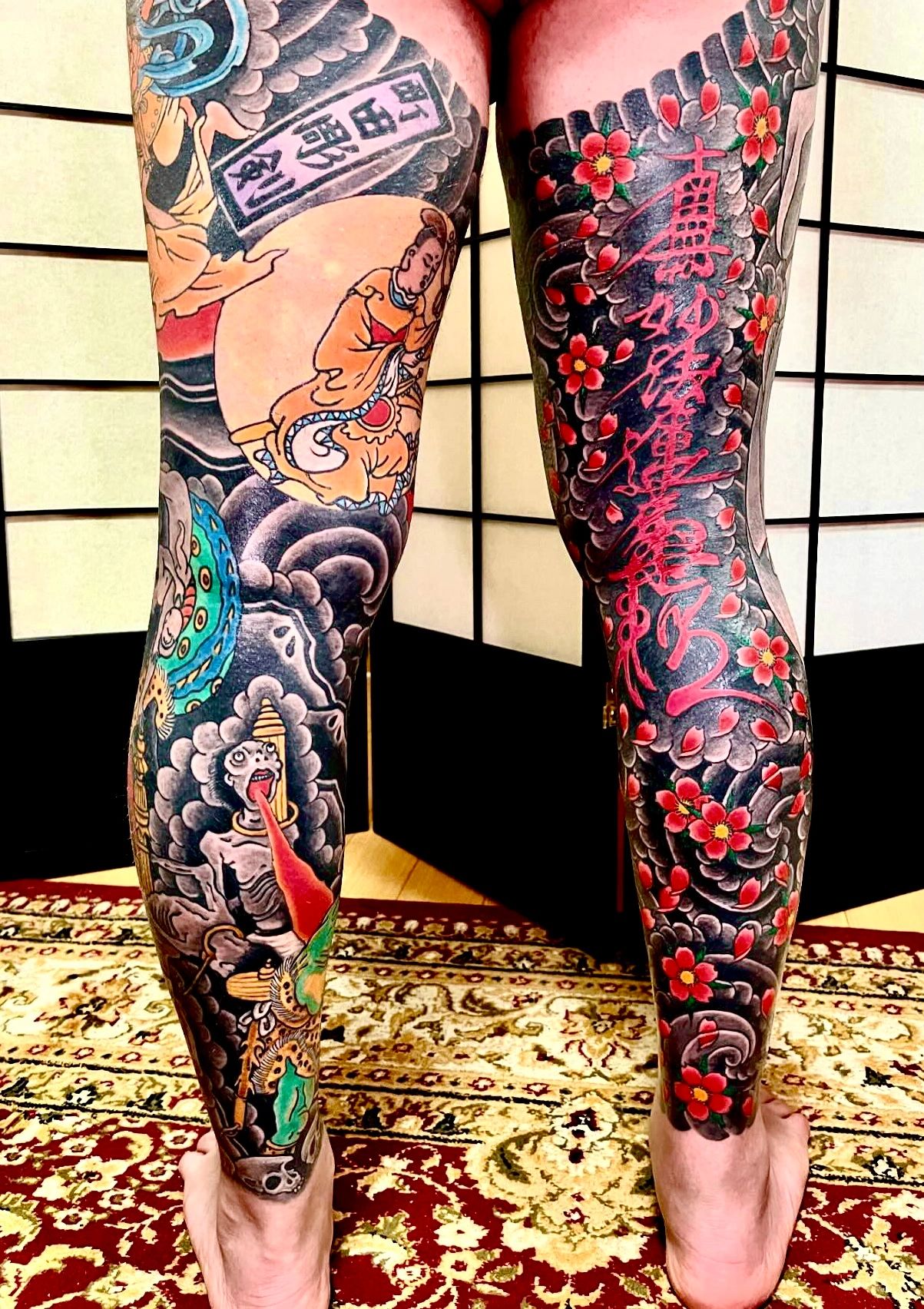
Another difference was that these last sessions were largely comprised of three days of monochromatic inking: two days of red, one day of green, and virtually nothing else. It occurred to me during the red sessions, in this Land of the Rising sun, and as my blood mixed indistinguishably with the ink on Horiken’s towels, that the color was revealing a sort of duality: red as life, red as death. The vivid red of the cherry blossoms beautifully symbolizes the vitality of life; the blood on the ghost and her victim points to violence and death. My own blood trickling down my leg blends thematically (and literally) with the representational blood dripping from the severed head onto the skull at my shin. A rebirth through violence: stabbed and spilling blood for the sake of art, offering up a little bit of my life to preserve and reaffirm a pair of 19th c. Edo/Meiji paintings, at least for a little while longer.
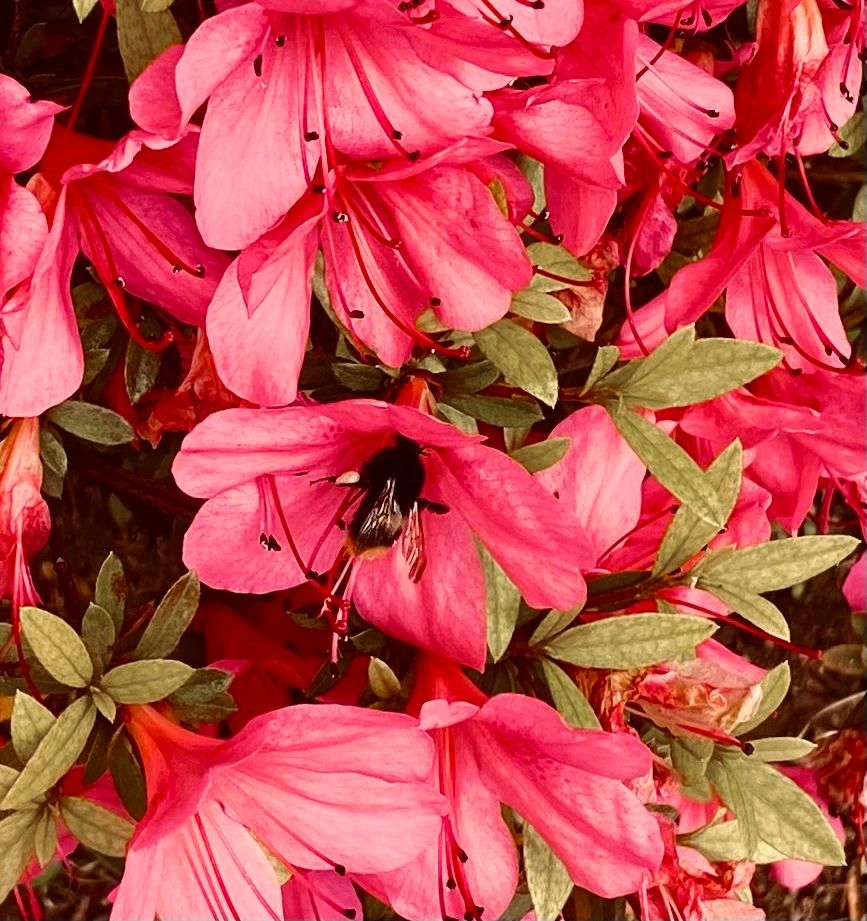
I thought of this outside a market as a bumblebee foraged among vibrantly crimson flowers. Red is everywhere, bathing life, death, violence and serenity in roughly equal portions.
As a dermatologist I’ve always had a complicated relationship with blood. Much of the time spent on skin surgery is devoted to stopping bleeding; it’s nerve-wracking when an open surgical wound is gushing so much blood you have a hard time even finding the spot it’s coming from. But at the same time an equally-important part of skin surgery is minimizing the tension exerted on a closed wound, so that blood can circulate freely during healing. Too tight a closure and the wound edges will likely dehisce, necrose or leave a lousy scar. Blood is life, and blood is also death. Kawanabe Kyosai understood the significance of blood in the two paintings used as reference images for my leg sleeves, plus I asked Horiken to add extra blood dripping front the severed head onto the skull below (taken from yet another Kyosai work). He did so immediately.
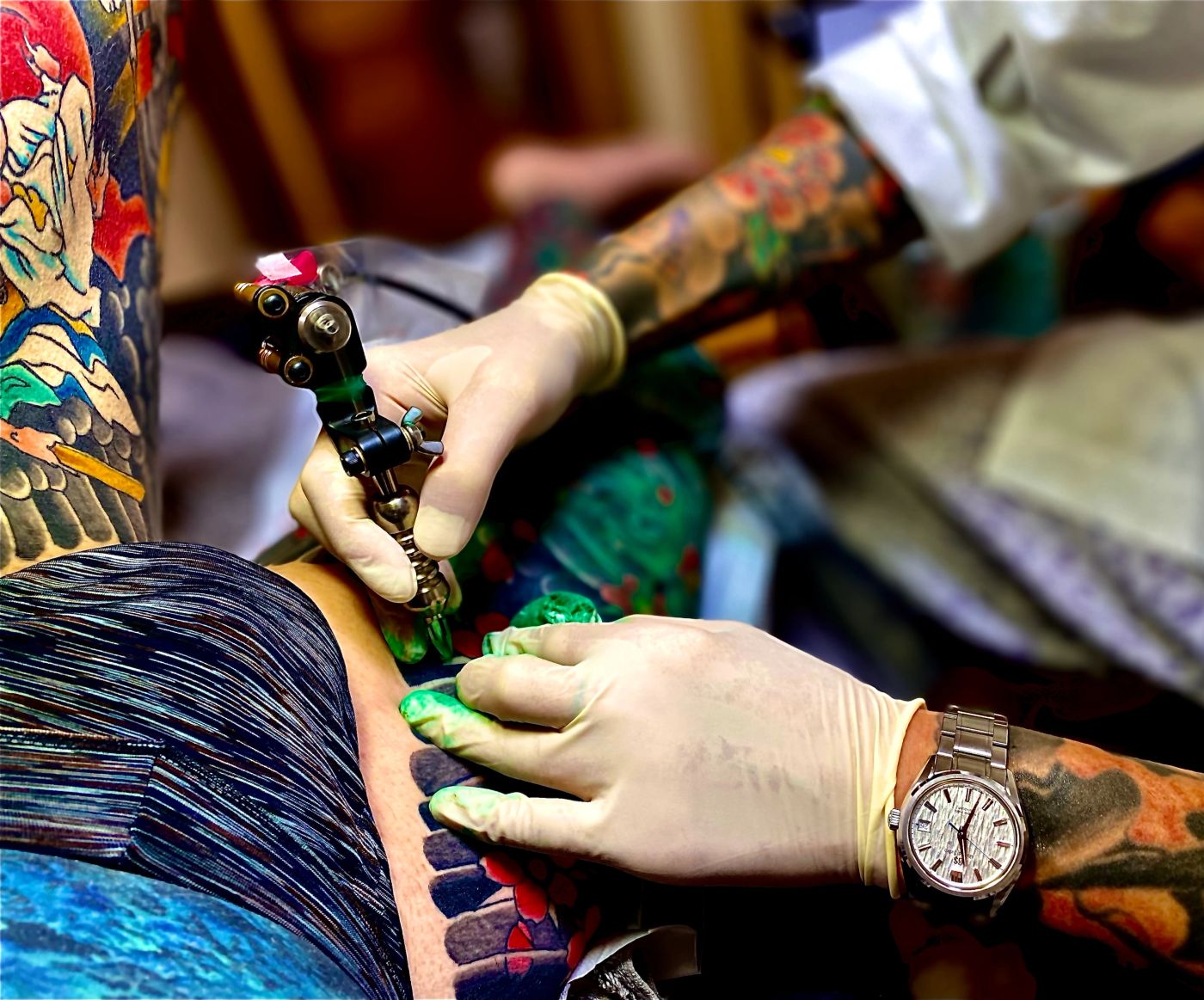
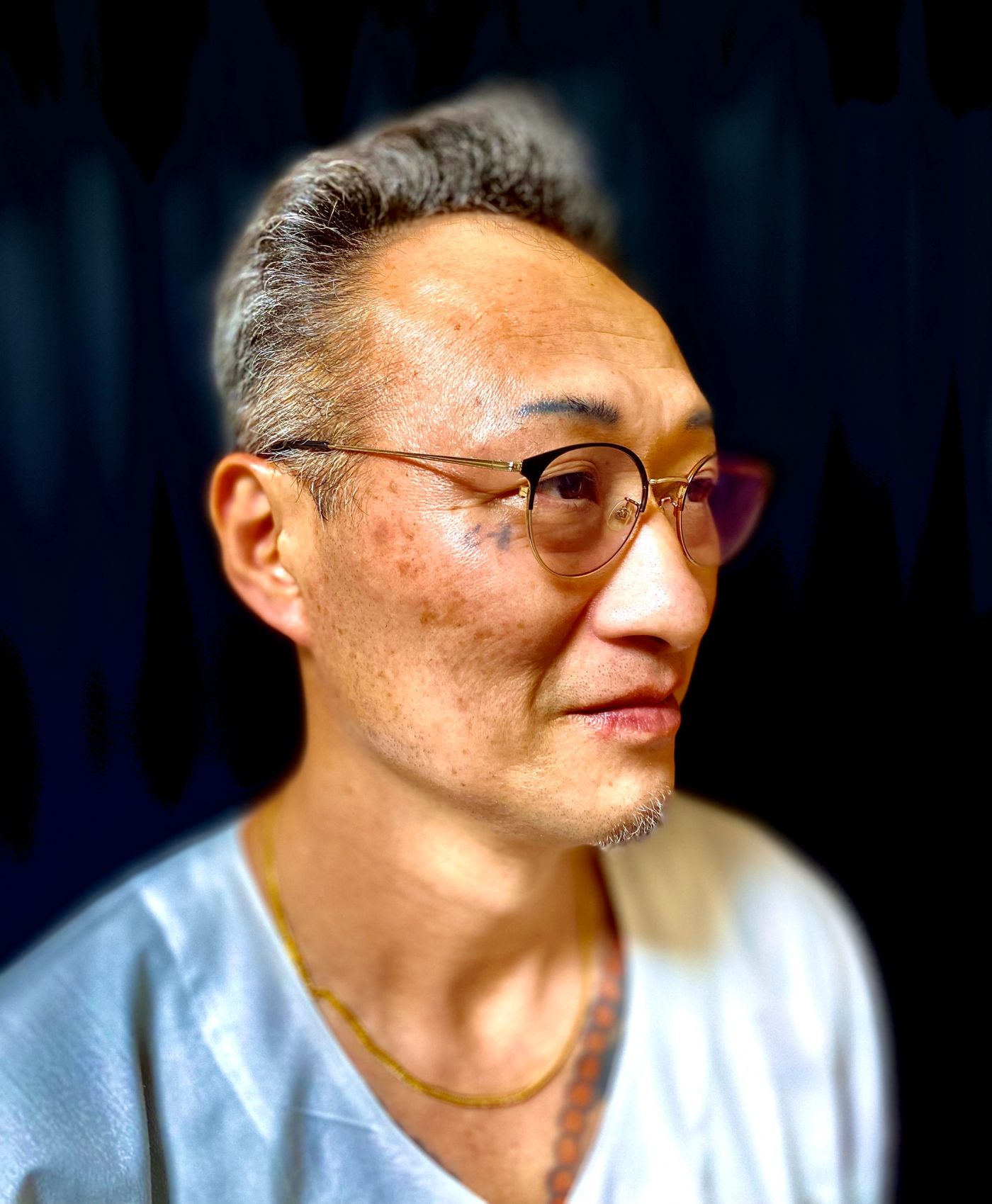
Now, nine days after the green and final session, everything is healed except for the red areas of the blossoms. This beautiful color is also irritating to the skin; I don’t think the scabbing present is a sign of allergy, as in the past I’ve had the same issue with fresh red and the problem eventually resolved by itself every time. A judicious use of superpotent topical steroid in only two applications really helped to calm this down and speed healing.
There is much I’ll miss about Japan, especially people like Machida Horiken and Humira, though one thing I certainly won’t will be the earthquakes: there were three noticeable ones over my six trips, and though they were relatively minor in our immediate area they were disturbing nonetheless. Small ones certainly aren’t destructive, but when the building starts shaking you don’t know what you’re going to get or for how long. That uncertainty is the unnerving part; I’m sure the locals get used to the little ones, as Japan has 500 measurable quakes per year, but these three were spooky for a novice like me. New Mexico may have many faults, but natural disasters aren’t currently among them, and I’m thankful for it.
——
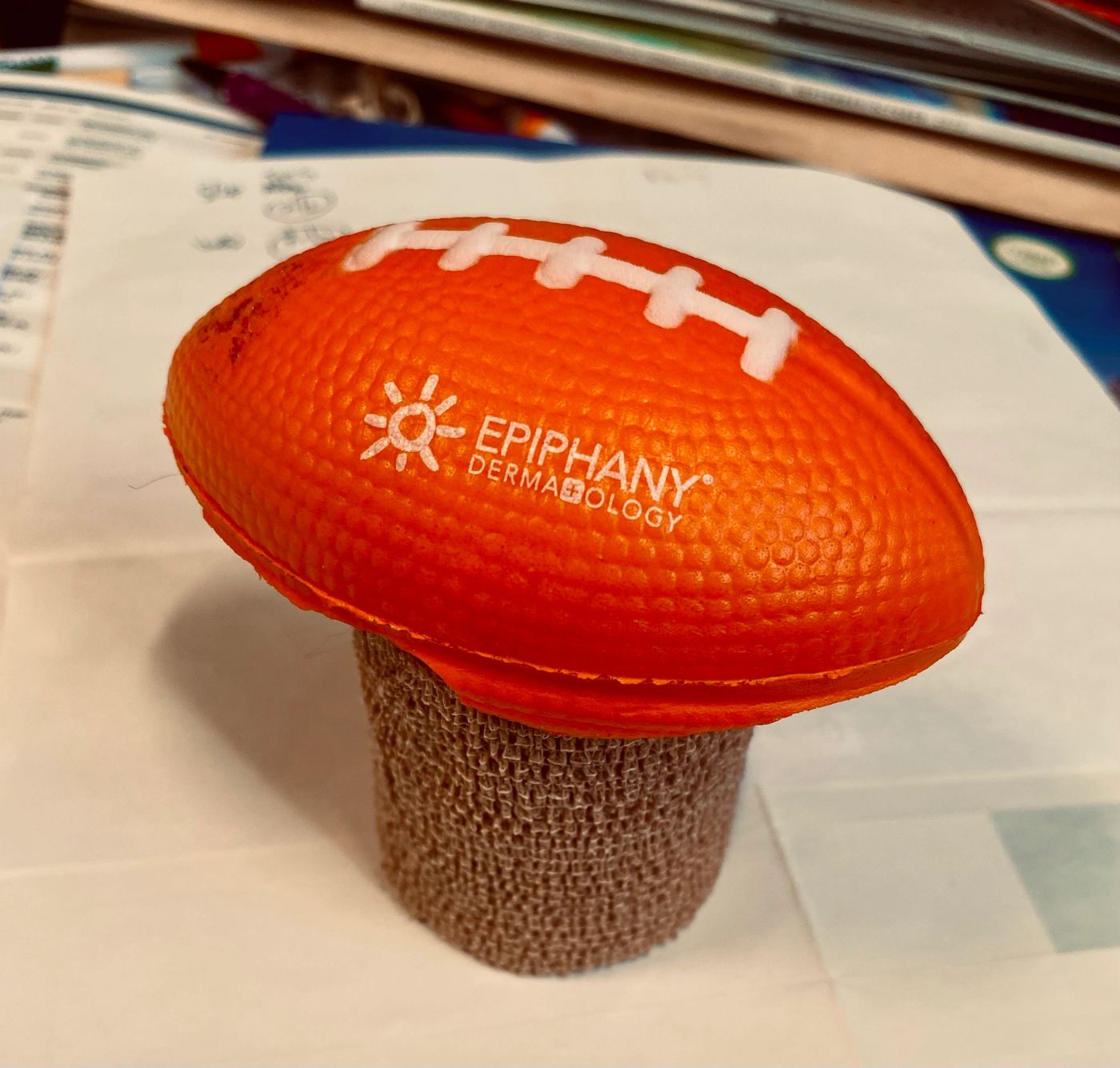
I’ve never seen any studies on the possibility of regional anatomical variations for tattoo infections, but I imagine that the legs have the highest risk: circulation and gravity pose healing problems, and with their position downstream of the butt-hole there is the added problem of E. coli and other intestinal bacteria flowing down the leg as you wash yourself in the shower. Certainly skin surgical risks are higher on the leg—I’d much rather operate on a silver-dollar-sized cancer on the cheek than a pea-sized one on the shin—and so it seems likely something similar applies with tattooing, though there is simply not enough research done to know. So I’m glad to be done on my legs without any sign of problems; I can say from experience that it’s pretty painful behind the knee and anywhere on the shin, so be prepared, that you should expect quite a bit of swelling, especially if you are flying, and that post-inking occlusive dressings are quite annoying behind the knee. The popliteal fossa goes in and out of concavity with every step, and wrinkles or bubbles from the difficulty applying dressings there tend to pull and rub as you walk. To date I’ve not found a fix, though I did find temporary relief by compressing the fossa with a jury-rigged hemisphere of a small nerf-style football. If anyone knows a trick about how to deal with ink healing behind the knee I’d love to hear about it!
On the subject of tattoo medical studies: there’s been some press recently about one purporting a slight increased rate of lymphoma among those with tattoos (20 percent excess risk). I wouldn’t worry just yet, as the study is pretty weak on several counts. First, the statistics weren’t robust: the confidence-interval crossed 1.0, meaning no difference between cases and controls was proven statistically. Second, the respondents with the least ink (but not no ink) had the most lymphomas—fewer than those with a lot of ink. Such a dose-response curve doesn’t exist for virtually all known carcinogens, where the more exposure you have, the greater the risk. Finally, the type of trial (case-control) is among the weakest type of clinical studies. So I wouldn’t be concerned just yet that there is any such risk.